9 Things I Wish I'd Known About My Knees At 50 (Instead Of Wasting £4,200 On Things That Didn't Work)
Three ex-physios in my family. One orthopaedic surgeon neighbour. Nobody told me about the wavelength that changes everything — until a 28-year-old sports scientist at a talk in Oxford drew it on a napkin.
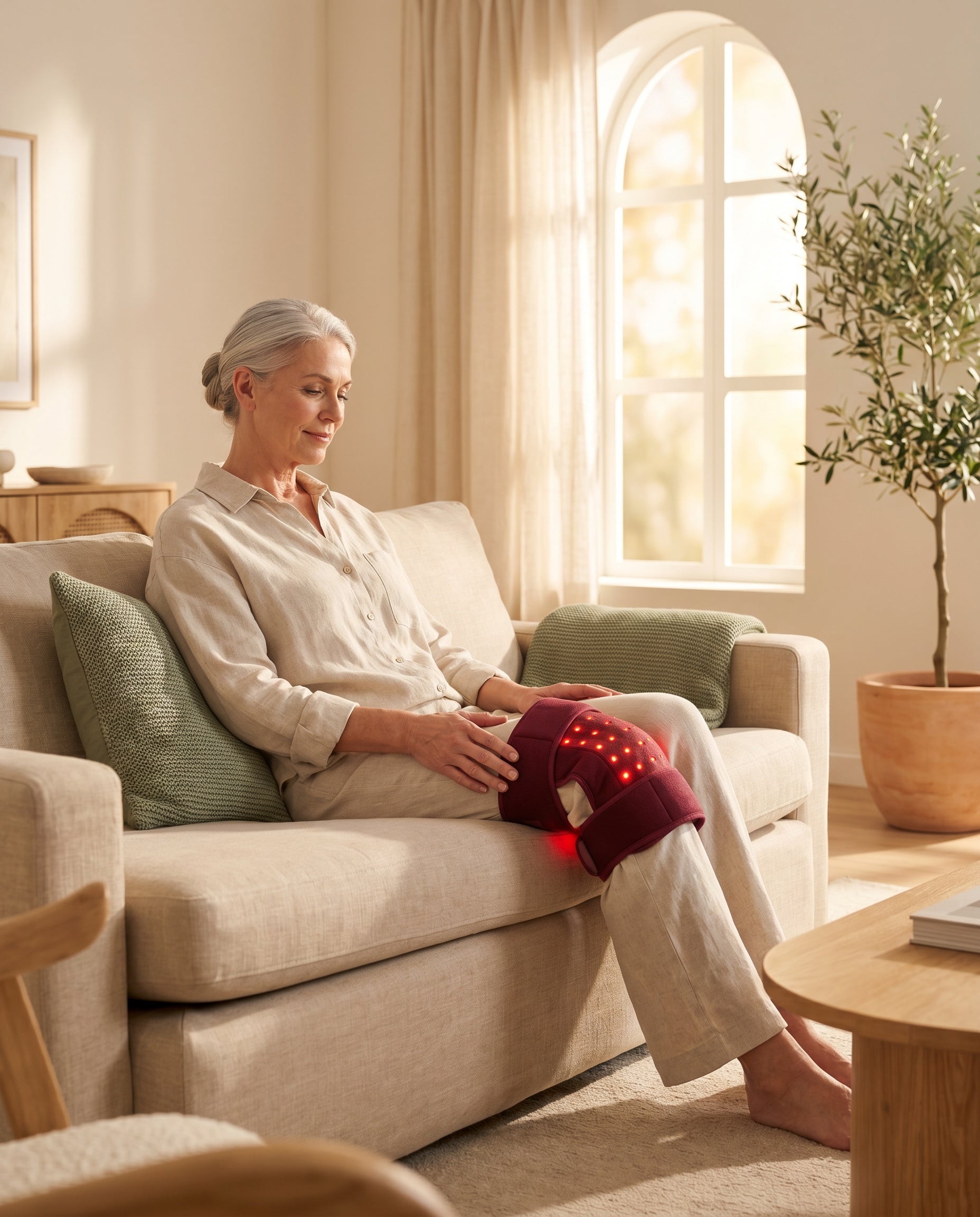
I'm 57. I played amateur rugby until I was 32. I ran half-marathons into my forties. At 49 my left knee started grumbling on descents. By 52 I was gripping the bannister going upstairs in my own house. By 55 I'd quietly stopped going on the annual Lake District walking weekend with the boys from university — I made an excuse every year.
Before this wrap, I spent roughly £4,200 chasing a fix. Orthotics. Steroid injections. Glucosamine. Turmeric. A TENS machine. Physiotherapy. An MRI. A knee brace so expensive the osteopath showed me how to wear it over my trousers. None of it moved the needle meaningfully.
What follows is everything nobody explained to me, in the order I wish someone had.
The Knee Pain Is Not "The Cartilage Wearing Down". Not Entirely.
The first GP I saw at 49 said, straight-faced, "you've got some cartilage wear — it's just ageing, David, welcome to the club". I left feeling 30 years older than I had when I walked in.
What that GP didn't tell me: most chronic knee pain in over-50s is roughly 60% soft tissue inflammation and synovial membrane irritation, not structural cartilage loss. The cartilage might look rough on an MRI — but the thing causing the pain is the inflamed tissue around it.
That's huge. Because you can actually do something about inflammation. You can't regrow cartilage. But you can absolutely calm inflammation — if you hit it in the right place, the right way.
Ibuprofen Masks The Pain. It Does Not Treat The Cause.
I was up to 1,200mg of ibuprofen a day by week 26 of the 2021 flare. My GP added a stomach protector. Then another. By autumn of 2022 my cholesterol had gone up, my blood pressure was creeping, and I was still in pain.
The 2023 MHRA review on long-term NSAID use is sobering: cardiovascular risk elevation starts at just 7 days of continuous use in adults over 50. My GP never mentioned it.
Turning the volume down on pain is not the same as fixing the pain. I wish I'd known that at 49.
Glucosamine And Chondroitin Are — I'm Sorry To Say This — Placebo For Most People.
I bought 27 jars of glucosamine between 2019 and 2024. Calculated at £14.99 per jar, that's £404.73. I took them religiously.
The 2010 meta-analysis by Wandel et al. in the BMJ (10 trials, 3,803 patients) concluded glucosamine, chondroitin, and the combination had "no clinically relevant effect on perceived joint pain or on joint space narrowing". The follow-up 2018 review said the same thing.
They work for about 1 in 5 people, at the margin, usually through placebo. I wanted to be in that 1-in-5. I wasn't.
The Wavelength Of Light Matters More Than "Red Light" Does.
This is the napkin drawing.
A 28-year-old sports-science PhD I met at a talk in Oxford in January 2025 (he was the nephew of a colleague) drew me two overlapping circles on a napkin. One labelled 660nm. The other labelled 850nm.
"660nm is what people think of as red light," he said. "It penetrates 5–10 millimetres. It's superficial. It does the skin and the surface capillaries."
Then he tapped the 850nm circle. "This one is invisible to the eye. Near-infrared. It goes 3 to 5 centimetres deep. This is the one that reaches the joint."
"The devices that work have both. The cheap Amazon strips have only the visible red. That's why they warm your skin but don't reduce your pain."
I'd spent £79 on a cheap LED strip in 2022. 660nm only. It did nothing. Now I knew why.
850nm Light Restarts ATP Production Inside Ageing Joint Cells.
Here's the mechanism that made me actually order a wrap within 4 days of meeting that PhD.
Your mitochondria (the battery-makers inside every cell) have an enzyme called cytochrome-c-oxidase. It's the last step in making ATP — the cell's energy currency.
As we age, and as joints inflame, cytochrome-c-oxidase gets sluggish. 850nm light is absorbed by cytochrome-c-oxidase and kicks it back into full gear. A 2017 paper by Michael Hamblin at Harvard Medical School demonstrated a 150–200% lift in mitochondrial ATP in the targeted tissue after photobiomodulation.
More ATP in joint cells = more collagen synthesis = actual tissue repair, not just masked pain. That's the bit the glucosamine can't do.
Clinics Charge £80 Per Session. The Wrap Delivers The Same Thing.
After the napkin conversation I booked 3 sessions at a sports clinic in London. £80 per session. The panel they used was a Beurer MG-something with 660nm + 850nm. The whole thing took 18 minutes.
I felt a difference after the second session. By the third I thought: this is a scam of scheduling, not of product. I went home and started looking for the same panel I could put on my own knee.
A personal RLT wrap with the same wavelengths and irradiance runs £149. Twenty clinic visits — the dose most people need — would cost £1,600. The wrap pays for itself 4 sessions in.
The Timing Of Sessions Matters Almost As Much As The Device.
I was spraying the sessions randomly — sometimes morning, sometimes evening, whenever I remembered. Results were patchy for the first 10 days.
The protocol sheet included with the wrap (which I eventually read, like a proper grown-up) said: 20 minutes, same time every day, ideally 1–2 hours before bed. The logic: sleep is when collagen synthesis is highest, and getting the ATP lift in late evening means the cells have fuel to repair overnight.
I switched to 9:15pm every night. Day 14 onwards was a different story. Read the protocol sheet. Follow the protocol sheet.
The First Thing That Improves Is The Morning.
Not the walking. Not the stairs. Not the kneeling.
The first shift — for me, around Day 6 — was that I got out of bed and walked to the bathroom without the 14-second warm-up shuffle. My knee just worked. I didn't notice for the first few mornings. My wife did. She said, "you're walking straight now."
The morning stiffness is usually the first to break because overnight inflammation clears fastest once you're giving the tissue the ATP to do it. Once mornings stop being painful, the rest of the day shifts too. The whole thing unwinds.
The Hardest Part Is Realising How Much Of Your Life You Gave Up For No Reason.
This is the one I didn't expect.
On Day 45 I did the Cumbrian walking weekend for the first time in 4 years. 11 miles on the Saturday with 380m of elevation. I had to stop twice, both for photographs. I sat by the tarn at lunch and it hit me hard — I'd given up 3 of those weekends. I'd made excuses for 3 years. My friends had stopped inviting me.
It wasn't anger. It was a grief for the years I'd written off as "my knees going". Because it turned out my knees weren't going. They were starved. And £149 and 20 minutes a day was all it took to feed them.
If you're on the fence, I am not going to tell you this wrap is a miracle. I'll tell you it was the first thing in 8 years that worked, and it worked fast. Use the 90-day home trial. If it's wrong for you, send it back. If it's right for you, you'll know by Day 14.
"The thing nobody tells you about getting older is how much of it is optional."
If Any Of This Rings A Bell — Read The Full Offer.
The wrap is currently on launch pricing (£149 single, £199 with 6-month pad club, £279 couple's pack). 90-day home trial. They collect it themselves if it's wrong for you.
I bought the single at launch. I bought a second one for my wife 6 weeks later. Make your own call — but read the actual research first.
See The Mechanism & Offer →Written by David R., retired architect, Tunbridge Wells. Compensated with a review wrap in exchange for an honest write-up. Timelines and opinions are his own.