I Thought Creatine Was for Gym Bros. Then My 62-Year-Old Mum Opened a Jar of Beetroot That Had Been Closed for Two Years.
The most-studied supplement in the world has been sitting in plain sight for 30 years. Why doctors rarely mention it to women, and why that's finally starting to change.
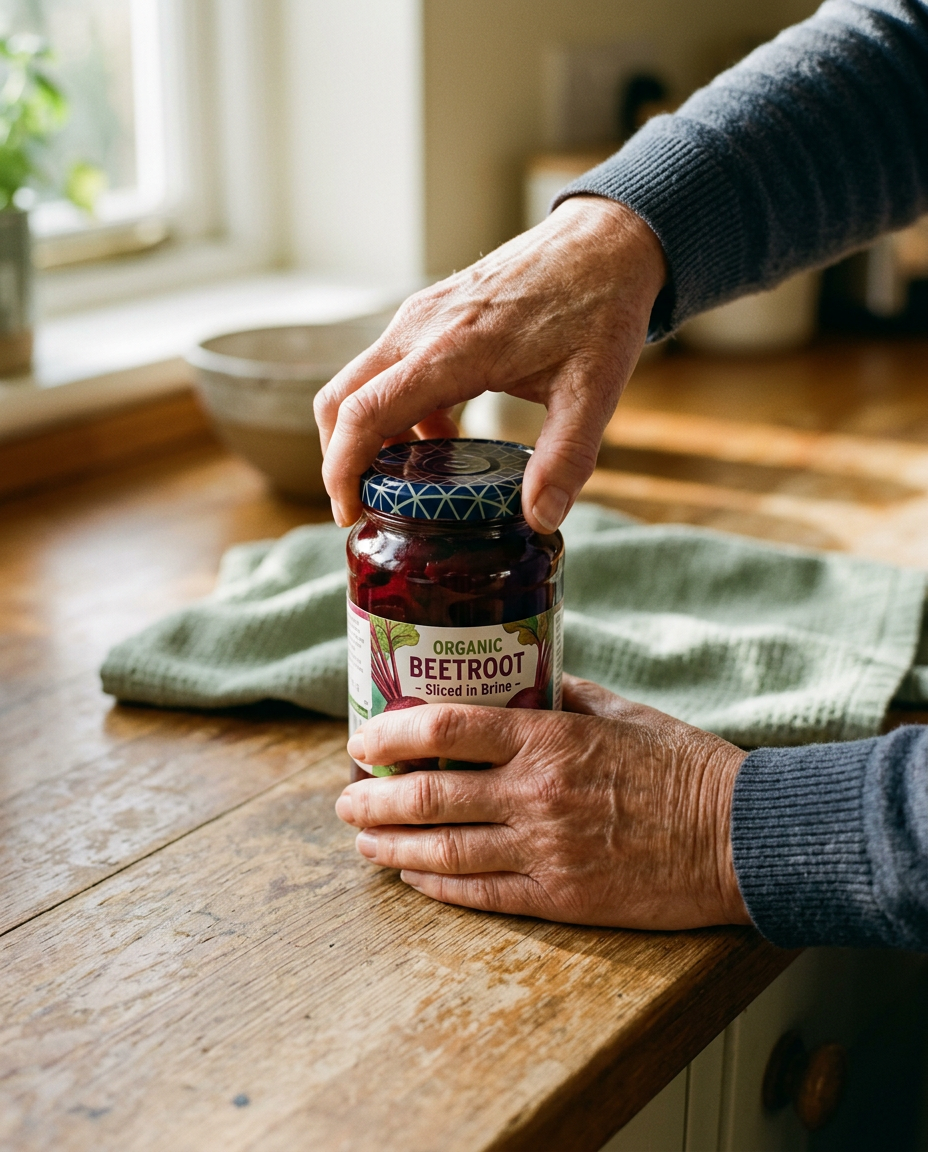
After two years of asking for help, this was the first jar my mum opened alone.
I didn't plan to write about supplements this month. I was writing about my mum.
She's 62. Two summers ago, she couldn't open a jar of beetroot without calling my stepdad. She laughed it off — "arthritis, probably" — the way women do. I noticed, said nothing. Three months later she fell off a kerb stepping onto a wet pavement in Bath, and for a terrifying nine seconds, she couldn't get up.
No break. No hospital. Just a moment where her body refused.
Her GP used the word I'd been avoiding: sarcopenia. Age-related muscle loss. It starts somewhere in your 30s — slow, silent, 3 to 8 per cent per decade — and most women don't notice until something refuses to work the way it used to. A jar. A set of stairs. A grandchild they can't lift.
The scary part isn't that it happens. It's that nearly every woman I spoke to — including me — thought "muscle" was a man's problem. It isn't. Muscle is the organ of ageing. It decides how long you keep your independence, how well you sleep, whether your brain stays sharp, whether your metabolism keeps pace.
And the single most-studied supplement in the world for muscle — yes, more than whey, more than collagen, more than magnesium, more than anything — is one that nine out of ten of the women I asked had never tried. Because, they said, "isn't creatine for gym bros?"
That's the lie.
The mechanism nobody bothered to explain to us
Here's what nobody tells you. Calcium and vitamin D protect bone. Collagen helps skin and joints. Protein powders give you raw material. But none of them give your muscles the one thing they actually run on — the chemical fuel called ATP.
Every time you lift, climb, stand up, or even think, your cells burn ATP. Your body re-synthesises it using a molecule called phosphocreatine. Phosphocreatine is made from creatine — 95 per cent of which is stored in your muscles, the remaining 5 per cent in your brain.
As you age, your natural creatine stores drop. Food barely moves the needle: to hit the clinical dose from diet alone you'd need to eat one kilo of raw steak every single day. Nobody is doing that.
So your muscles run on empty. Your workouts plateau. Your strength drifts downward. Your brain — which also runs on creatine — gets foggier during stress. And because muscle burns calories 24/7, your metabolism slows faster than it should. It's a compounding decline, and it started earlier than you think.
Not a stimulant. Not a hormone. Not a magic pill. Just a molecule your body already makes, that you're running out of, that 1,400+ peer-reviewed studies have shown — at a consistent 5g/day — can rebuild what age is quietly taking.
The International Society of Sports Nutrition calls it "the most effective ergogenic nutritional supplement available." The most cautious institutions in the world (NIH, Mayo Clinic, Harvard) have it in the "safe and effective" column. A 2022 meta-analysis found improvements not just in strength, but in memory, reasoning, and mood — especially in women and older adults.
And until recently, the only way to take it was by mixing a gritty white powder into water and hoping for the best.
Why most creatine gummies are broken
Here's the catch nobody mentions. Most "creatine gummies" on the market right now are under-dosed. A typical bottle labels itself "creatine" but delivers 1 to 2 grams per serving — a third of the clinical dose. You'd need to eat four to six gummies a day, plus you're getting their sugar, their flavourings, their fillers.
One UK company — Grove — is dosing differently. Their gummy is the first on the market I found that matches the actual clinical literature: 5 grams of creatine monohydrate per daily serving, the exact amount every published study uses. Micronized, pH-stabilised, built to dissolve cleanly so the creatine actually reaches muscle tissue.
No sugar spike. No chalky aftertaste. No loading phase. No shaker bottle.
Two gummies. Once a day. With coffee or without.
What 60 days looked like for three women
My mum started 60 days ago.
Day 31 she texted me a photo of the jar of beetroot, open, on the counter. Her caption was three words:
"Got it. Alone."
She doesn't go to the gym. She didn't change her diet. She walks the same loop she's walked for 20 years, around the park by the canal. What changed is that on a Tuesday in March she had the grip strength she used to have in 2019, and she noticed it in the most ordinary moment possible — standing at her own kitchen worktop, making a salad for one.
I texted my friend Claire, who's 41 and a paramedic. Two kids. Broken sleep. "Permanently knackered," in her words. She tried it because I told her, sceptically, "it's not just for gym bros, you know." She texted me a fortnight later:
"I don't feel more energetic exactly. I feel more there. I picked my son up at the end of a 12-hour shift yesterday and my arms didn't burn. I haven't had that in five years. I'll keep taking them."
And then there's me. I'm 38. I took Grove every day for eight weeks while writing this piece — as a deliberate test, not a belief. I don't care about lifting heavier. What I noticed was that by week three, the 4 pm brain fog I've had my entire adult working life stopped arriving. I wrote this article in one morning session, which is not a thing I normally do.
Three women. Three decades apart. One small molecule.
The question I kept asking
Why didn't any of us know this?
The answer is uncomfortable. Creatine has been studied since the 1970s. The bulk of the research uses young male athletes because young male athletes are easy to recruit. When researchers started including women in the late 2010s, the results were better than expected — particularly for women over 40, women in perimenopause, and women reporting cognitive symptoms.
But the marketing had already calcified. A molecule that should have been positioned as a longevity staple got stuck in the gym-bro aisle for 30 years.
It's finally getting out.
The 90-day question
Here's what I'd tell anyone reading this who's over 35: you don't need to take my word for it. The science is settled. The safety profile is ironclad. The dose is known. The only question left is whether you respond.
Picture yourself three months from now. Your coffee's gone lukewarm next to you, and you realise you've been working for two hours without getting up to pace. Your toddler holds their arms up at the end of the day and you lift them without bracing your lower back. You open the jar. You climb the stairs two at a time because you can. You sleep through the night because your body isn't fighting itself.
That's not a promise. That's what the best-responding third of women describe at the 90-day mark, in paper after paper, across two decades of research.
The worst-case scenario is you notice nothing and you're out the cost of a few weeks of coffee.
Grove is offering 14 days for £19
Two gummies a day. The full clinical 5g dose. Free UK shipping.
If you don't feel stronger, sharper, and steadier by day 90, they refund you in full and you keep the jar. No quiz. No subscription lock-in.
See the 14-day trial →A note on conflicts: I was given a bottle to test. I paid for every bottle after that. Grove did not review or edit this article. The opinions and data are mine.